Computer at the Wheel FH Aachen scientists conduct research in the field of automated driving
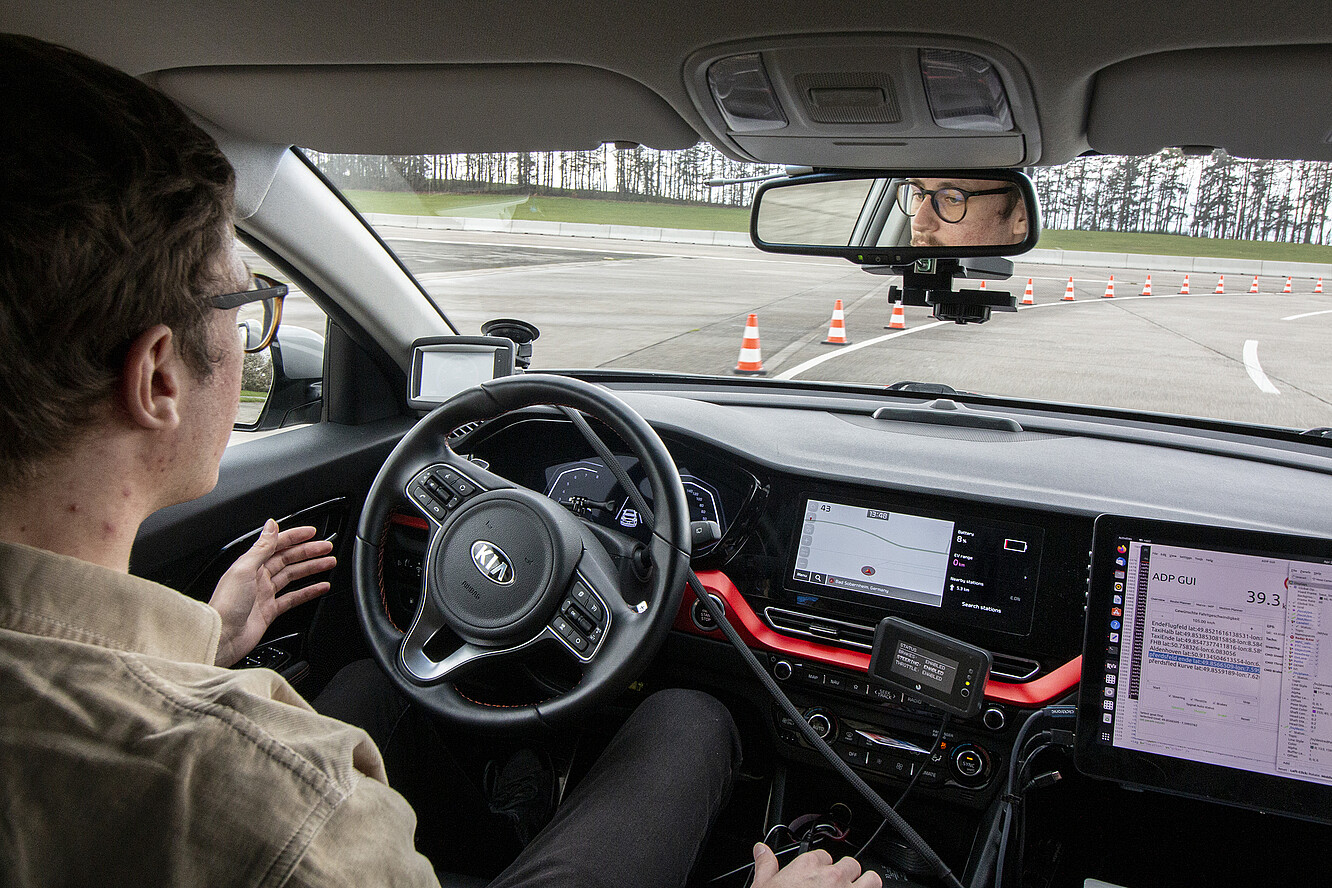
As if by magic, the Kia Niro navigates the bend of the road. The car turns into the acceleration lane, accelerates and threads its way into the moving traffic on the motorway. Joschua Schulte-Tigges is sitting at the wheel, keeping his hands and feet still. With bated breath, the FH employee and his two fellow passengers - research engineers from the European Hyundai R&D Centre - are observing the vehicle's performance in the complex situation. What makes it special is that the Niro is a research vehicle that drives autonomously.
Real-time Data Processing
We are somewhere in the middle of nowhere, more precisely in the Pferdsfeld Industrial Park on the Hunsrück heights. Manufacturers and research institutions use the Hunsrück testing area to trial new technologies. The Hi-Drive research team, which includes not only the FH Aachen scientists but also experts from HMETC (Hyundai Motor Europe Technical Center), Rüsselsheim, and other companies in the automotive industry, are able to complete the first test drives with the autonomously driving car in a safe environment here. As the Niro navigates the bend, it becomes clear just how complex the test scenario is: the car's computer system determines the appropriate steering angle and speed on the basis of GPS data, as well as live data from a distance radar and several lidars and cameras. This huge amount of data is processed in real time, which places the utmost demand on the computer - which leads to quite a noticeable jolt in the bend when the control system adjusts the course. This is why Joschua Schulte-Tigges always keeps his hands close to the steering wheel so that he can intervene at any time and maintain manual control of the vehicle. These are the first test drives in which the car drives autonomously and automatically adapts to the Car-2-Car assisted situation - for the team, it's a milestone on a long journey.


In the Acceleration Lane
Dr Michele Rondinone and Daniel Kaszner, research engineers and Car-2-Car experts in the Advanced Safety Control team at HMETC, explain: "When it comes to Car-2-Car communication and the current deployment activities in Europe, we are in the acceleration lane in terms of cooperative automated driving (CAD)." More specifically, it is about integrating the infrastructure as well as other vehicles via Car-2-Car communication as additional "sensors" for recording the environment and, thereby, expanding the field of vision beyond the limits of the vehicle's actual sensor technology.
The Problem is Always Other People
"There are many subject areas in the research field of autonomous driving - from technical aspects such as sensor technology, image processing and environment recognition to legal issues as well as philosophical-ethical challenges," says Prof Dr Michael Reke, head of the Vehicle Software Laboratory and the Automated Driving Research Group at FH Aachen's Institute for Mobile Autonomous Systems and Cognitive Robotics (MASKOR). The focus of this research project is on improving the vehicle's communication with its environment - to put it simply: the problem in road traffic is always other road users.
The Challenge of Communication
Driving onto the motorway is an example of these challenges. You not only have to gauge your own speed and position, but also that of other vehicles. "Over the next twenty years, we will have a situation where automated and non-automated vehicles are travelling in parallel in road traffic," says Professor Reke. When two or more automated vehicles are involved, the challenge lies in organising the communication between the cars in such a manner that the systems "understand" each other. When non-automated cars are in play, it is more a question of recognising the environment by means of radar and imaging systems. The research team's Kia Niro is jam-packed with technology - in addition to the sensors, communication systems and computers, there are also displays on which the scientists can check how the control processes are running while driving.


The Human Aspect
Thomas Walter, head of the Advanced Safety Control team at HMETC, emphasises the value of the collaboration with FH Aachen: "Research into automated driving functions within the context of the regional conditions here in Europe is an important issue for the Hyundai Group. This is why we are delighted to have found a long-term research partner in FH Aachen, with whom we can work together and in a practice-oriented manner on EU projects such as Hi-Drive."
However, scientific and technological advances are only one side of the coin - the emotional-human aspect is the other. Autonomous or automated driving is a topic that engages many people. Anyone who is out in traffic every day knows how difficult it is to keep track of everything and act appropriately. Accordingly, the thought of handing over control of the steering wheel to a computer is an unpleasant one for a great number of people. It will be crucial for the acceptance of the new technologies that drivers feel safe and comfortable on the road. There is still a long way to go before the technologies developed at the MASCOR Institute will be deployed in serial use. However, elements of them will soon find their way into everyday life, especially in the form of assistance systems. "In the next few years, we will probably only be putting automated driving into practice," says Professor Reke, adding that it will be a long time before autonomous driving is used in normal road traffic.
Laboratory at the KMAC
"The sensor technology required for recording the surroundings and the fusion of the resulting data into an image of the environment place high demands on the hardware and software," says Dominik Matheis, research engineer and sensor/AD expert in the Advanced Safety Control team at HMETC. The aim is to manage even complex driving scenarios - at least as well as a driver could, or, ultimately, for safety reasons, even better.
Driving on the test track is important for Professor Reke's team, but a large part of the research work takes place in the laboratory, which is housed in the new Competence Center for Mobility (KMAC) at FH Aachen. Here, the scientists also have access to a driving robot. The system can be installed in different types of vehicles. "With the help of the driving robot, we can remotely control any vehicle and convert it into a vehicle with automated control," says Prof Reke. He explains: "Even with a built-in robot, a safety driver can sit in the driver's seat and override the system's driving interventions at any time. This provides us with the opportunity to test our self-developed control systems for fully automated driving in almost any vehicle."
Interdisciplinary Research
In just a few simple steps, the mounting plate is attached to the seat rail of the vehicle. The actuators, the arms and legs of the robot so to speak, are attached to this mounting plate. They convert the control commands and operate the accelerator, brakes and steering. The electric control unit with integrated safety function is positioned behind the driver's seat. "The MASCOR Institute at FH Aachen has been conducting successful research in the field of autonomous driving in numerous projects for several years now," says Professor Reke. The particular focus of the institute's work is on interdisciplinarity and the mutual exchange of the latest findings in the field of robotics and automotive technology. As a result, the control software developed in his laboratory is not only being tested in cars, but also in utility and special vehicles used in mining, for example.
